
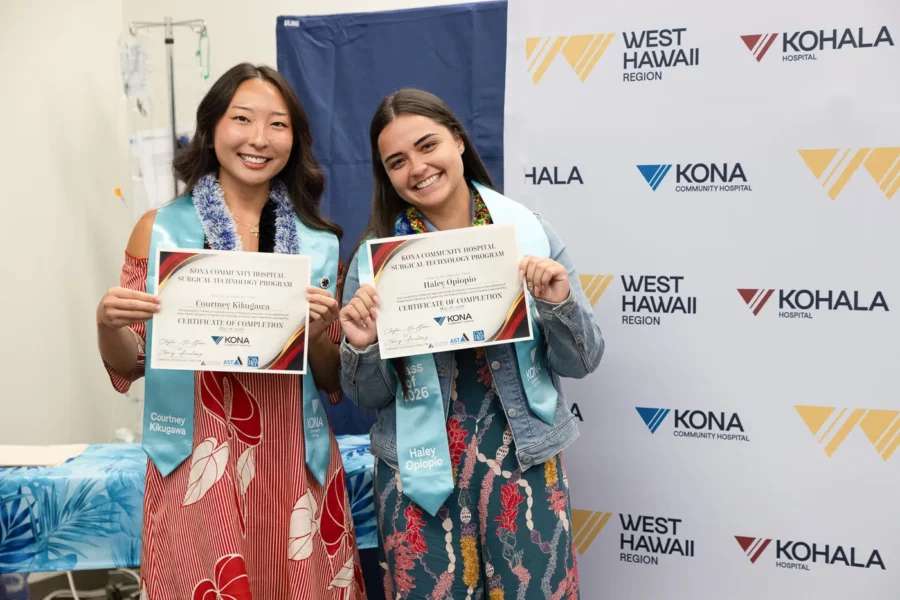
Hours of Operation:
Classroom and clinical hours are 6:45 AM to 3:15 PM Monday through Friday
The program director or clinical instructor is available at all times during the classroom and clinical hours.
Holidays and Breaks:
Holidays and breaks are provided during the program year. All holidays and breaks will coincide with The Kona Community Hospital calendar. The calendar will be provided at the beginning of each school year.
Our full-time 10 month program is divided into intensive didactic instruction and supervised laboratory. The classroom time totaling over 900 hours includes basic introduction to surgical technology courses as well as surgical-specific courses. Clinical time totaling over 500 hours is scheduled for the students. NO CALL rotation time is required by the Program. If the student exceeds the allowed number of absenteeism, then make up hours must be scheduled at the convenience of the instructor and the clinical site.
Additional laboratory practice may be scheduled as needed for the student to increase proficiency. Clinical students must complete a minimum of 120 cases in the first scrub role to graduate.
Program Information Sessions:
Program Information Sessions are held by appointment only. Please call 808-333-6771 to make an appointment.
Surgical Technologists may find employment:
Surgical technologists find employment at hospital operating rooms, outpatient care centers, ambulatory surgical facilities, and specialized physician offices. Surgical technologists also have a variety of additional employment opportunities including but not limited to:
- Surgical assistant
- Medical sales representative
- Organ and tissue procurement technician
- Surgery scheduler
- Anesthesia technologist
- Employed as a private consultant
- Sterile processing
- Surgical Technology instructor and/or program director
- Cardiovascular (CVOR) orthopedic
- Neurosurgery
- Obstetrics & gynecology (OB/GYN)
- Ear, nose and throat (ENT)
- Ophthalmic
- Plastics reconstructive surgery
- Urology
- Private practice specialist
- Oral Surgical Facility
Some graduates take advantage of travel agencies to explore employment opportunities across America.
Full Career Details:
Occupation Profile for Surgical Technologists | CareerOneStop
Didactics:
The classroom moves at a rapid pace and requires the student to use critical thinking skills. The Laboratory setting is hands-on and prepares the student for the clinical portion of the program. The instructor is competent and knowledgeable in the course material.
Clinical:
The student is allowed to participate in the clinical portion after classroom and laboratory instruction and passing with a grade of 80% or better. The student will work in the operating room alongside their assigned preceptor, helping the surgical team anticipate the surgical needs of the patient.
The student is responsible to be prepared and show initiative at the clinical assignmentand receive constant feedback regarding their performance. A mentor may include a surgeon, preceptor, or nurse and will be available at all times for mentoring and guidance.
Graduation Requirements:
Graduation requires completion of all academic and clinical requirements contained in the program curriculum/syllabus in the order outlined. Each course is a prerequisite for the subsequent course.
In addition to the didactic and clinical requirements, the student is required to take the NBSTSA certification exam prior to graduation. The fee for the testing is included in the AST membership.
Membership in the Association of Surgical Technologists is required.
Immunizations:
Evidence of immunity:
- Measles (rubeola)
- Mumps and rubella by immunization or titer.
- Chicken pox (Varicella Zoster) by history, immunization (two-dose vaccination), or titer.
- Hepatitis B by surface antibody titer, a positive marker for Hepatitis B, or evidence of the Hepatitis B immunization series.
- Diphtheria and tetanus
- Influenza vaccine
- Poliomyelitis vaccine
- COVID vaccines are now optional
- A 2-step Mantoux purified protein derivative (PPD) skin test within the last 12 months. If a positive PPD results, a recent chest x-ray report and physical examination documenting absence of fever, fatigue, night sweats, unplanned weight loss, and cough.
- The program will keep the records of student’s requirements and can provide them at the clinical site or healthcare systems request.
- The 3-injection Hepatitis B vaccine series is required. Students must show proof of at least the first injection in the series prior to the start of the health career program. Students must then follow through with the remaining injections in the series and provide proof of the injections (1st vaccination, 2nd vaccination at 4 weeks, 3rd vaccination at 5 months).
Student Work Policy:
If working while in the program, part-time evening and weekend employment is best. We encourage students to limit outside employment. A full-time job makes it very difficult to meet the program requirements.
Academic Requirements:
The Kona Community Hospital Surgical Technology Program does not award D grades.
Students are required to maintain an 80% academic average throughout the program. If unable to do so, the student is subject to termination from the program. An academic probation will be in effect if the GPA is less than 80%.
The faculty reserves the right to request the withdrawal of any student at any time whose health, clinical performance or conduct does not meet the required standard.
Number of Credits / Clock Hours Required For Program Completion
Credits: 77.3
Hours: 1665
Can I Be Enrolled Part-Time In the Surgical Technology Program?
No, coursework is completed only on a full-time basis. All coursework in each phase must be taken concurrently.
- Travel Requirements: Students will be expected to attend surgical rotations. Clinical rotations will rotate from Kealakekua, Kona, and Waimea. KCH and the Surgical Technology Program are not liable for any accidents during the off-campus surgical rotation.
- Attendance is mandatory to fulfill clinical hours set forth by the Association of Surgical Technologists.