
The Admitting Department assists you with your hospital admission.
The admissions clerk will complete paperwork associated with your hospital stay, such as personal and financial information, including:
- Personal identification (driver’s license, state identification card, green card, passport, etc.)
- Billing address, phone number, employment information, next of kin or emergency contacts, and other demographic information.
- Correct and valid health insurance cards and claims filing addresses.
- Financial counseling is available if needed.
If you are unable to give complete information when admitted, you will need to follow up with the Admitting Department during your hospitalization. If insurance information is not provided, you will be billed directly, and considered responsible for the entire balance.
Your Right to Make Decisions About Medical Treatment
You have a legal right to make decisions about your future health care, and to plan now for your medical care if you are not able to speak for yourself in the future. Ideally, you have already thought about such matters at home, and took the opportunity to discuss them with your loved ones. But many patients have not focused on end-of-life decisions until confronted with a serious illness or injury that requires a hospital admission. Recognizing that this may not be the ideal time to consider such important decisions, we still take this opportunity to give information about advance healthcare directives.
The Patient Self-Determination Act is a federal law that requires every adult at the time of hospital admission to receive written information about an individual’s right to make decisions about future medical care. This includes the right to accept or refuse treatment, and the right to create advance directives.
An Advance Healthcare Directive is an important legal document that describes a patient’s treatment wishes. It is your written statement, a legally enforceable document, stating your wishes for medical care in case of a terrible illness or injury. It also allows you to choose someone to make decisions for you if you are not able to make them or speak for yourself. This person is a surrogate, or substitute decision-maker, someone who knows you well and is familiar with your wishes and preferences. If you do not have an advance healthcare directive and need help to make one, ask the Admitting Clerk or your nurse to call our Social Worker.
When you are in our care, it is important to let us know when you have pain.
- Call your nurse as soon as you have pain. Taking pain medication early will help give you better pain relief.
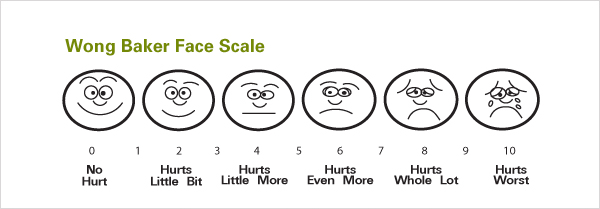
- Your nurse will teach you how to rate or score your pain. We use a scale from 0 to 10, where 0 = no pain and 10 is the worst pain.
- Handling pain is different for every person. Tell your nurse what number (0 to 10) best describes the pain level you want treated. Your nurse should ask you for your pain goal (lowest pain level number you expect to achieve pain relief).
- If you have difficulty communicating, we have special tools, such as the image below, that can help you communicate your pain to us.
Questions About Safety: Healthcare organizations across the country have made healthcare safety a priority. Everyone plays a role. As a patient, you have a responsibility to be an active, involved and informed partner on your healthcare team. Your health is too important to worry about being embarrassed if you don’t understand something that your doctor, nurse or other healthcare professional tells you. Don’t be afraid to ask about your safety.
- Pay attention to the care you are receiving.
- Expect all healthcare staff to introduce themselves when they enter your room, and look for their identification badges. If you do not see identification, ask the person to introduce him or herself, and tell you his or her role in your care.
- Make sure the staff checks your name band before giving you medicine, taking blood, or doing any procedure.
- Please observe the safety precautions that have been designed as part of your treatment plan. For example, you may be asked not to get out of bed without someone helping you.
- A nurse call light has been given to you so you can call for help if needed. Please be sure to keep it within your reach. Do not hesitate to call for help for any reason.
- Educate yourself about your diagnosis, the medical tests you are having and your treatment plan.
- Learn about your condition and treatments by asking your doctor or nurse.
- Write down important facts.
- Read all medical forms and make sure you understand them before you sign anything. If you don’t understand the form, ask a doctor or registered nurse to explain it to you.
- Ask about test results. Do not assume that everything is OK if you do not hear.
- Depending on your reason for being hospitalized, staff and visitors may have to take certain precautions. Often this is to prevent the spread of infection. Your doctor will discuss this with you if this is necessary. Your cooperation and understanding is appreciated.
- Know what medications you take and why you take them.
- If you are given an intravenous (I.V.), ask the nurse how long it should take for the liquid to “run out.” Tell the nurse if it doesn’t seem to be dripping properly (for example, going too fast or too slow).
- Make sure your doctors, nurses and pharmacists know about everything you are taking. This means prescriptions, over-the-counter medicines and dietary supplements like vitamins and herbs.
- Ask why you are taking the medications when they are prescribed and when you receive them.
- If you do not recognize the name or appearance of a medicine, make sure it is for you.
- Make sure your doctors, nurses and pharmacists know about allergies and adverse reactions you have had to any medicines.
- When your doctor writes a prescription, make sure you can read it.
- Speak up if you have questions or concerns, and if you do not understand, ask again. You have a right to know.
- Please advise your nurse about any safety concerns you may have. Some examples of this might be: “I didn’t get my medicine on time” or “I didn’t see the nurse or doctor wash their hands” or “The staff are not wearing their name tags.”
- Doctors, nurses and other health care providers come into contact with lots of bacteria and viruses. So before they treat you, ask them if they have cleaned their hands.
- If you do not see healthcare workers washing or sanitizing their hands on entering your room to care for you, we want you to speak up and ask the staff members to wash or sanitize their hands. You may also ask to speak to the Nurse Manager who will speak with the staff member.
- Health care providers should wear clean gloves when they perform tasks like taking throat cultures, taking blood, touching wounds or body fluids, and examining you. Don’t be afraid to ask them if they should be wearing gloves.
- Participate in all decisions about your treatment. You are the center of the healthcare team.
- If you feel you are too ill to assume this responsibility, you should ask a family member or authorized representative to ask questions on your behalf. Make sure your family member or authorized representative understands your preferences for care and your wishes concerning resuscitation and life support.
We want to encourage you, as the patient, to speak openly with your health care team, take part in your treatment choices, and promote your own safety by being well informed and involved in your care. Because we want you to think of yourself as a partner in your care, we want you to know your rights as well as your responsibilities during your stay in our facilities. We invite you and your family to join us as active members of your care team.We want to encourage you, as the patient, to speak openly with your health care team, take part in your treatment choices, and promote your own safety by being well informed and involved in your care. Because we want you to think of yourself as a partner in your care, we want you to know your rights as well as your responsibilities during your stay in our facilities. We invite you and your family to join us as active members of your care team.
- CONSIDERATE AND RESPECTFUL CARE —You have the right to be treated in a safe and secure setting, free from discrimination, abuse, or harassment.
- TEACHING FACILITY—This facility is a teaching environment where residents, students, and other health care professionals may participate in your care under appropriate supervision. Except in emergency situations, you mayrequest that residents or students not be involved in your care. It is not always possible to honor such requests, but we will try to do so to the extent that such restriction will not adversely affect your treatment or safety.
- INFORMATION ABOUT TREATMENT—You have the right to be informed by your physician of your diagnosis, treatment, prognosis, and proposed procedures, including the risks, benefits and alternatives in terms that you understand. You have the right to know the names and roles of involved in your care. You, or your authorized representative, may access your medical record within a reasonable time frame, as permitted by law.
- PARTICIPATION—You have the right to participate in decisions about your care, including planning and treatment. You may decide whether family members or others participate in your care. You have the right to refuse treatment, including life-sustaining treatment, to the extent permitted by law.
- TREATMENT AND TRANSFER— You have the right to receive care within the facility’s capacity, mission, and policies. If care cannot be provided, or is no longer appropriate, you will be informed of available alternatives. When medically appropriate and accepted by the receiving facility, you may be transferred to another facility.
- INFORMED CONSENT—Except in emergency situations, you have the right to receive information about the benefits, risks, and alternatives of procedures or treatments requiring consent. You may refuse any recommended procedure or treatment and the risk associated with refusal will be explained to you.
- ADVANCE HEALTH CARE DIRECTIVES—You have the right to create an Advance Health Care Directive and to a person to make health care decisions on your behalf if you are unable to do so, consistent with applicable law and facility policy.
- PROTECTIVE SERVICES—You have the right to request information about protective service when appropriate. Information will be provided upon request.
- PAIN MANAGEMENT—You have the right to have appropriate assessment and management of pain consistent with your condition and treatment plan.
- ETHICAL ISSUES/END OF LIFE CARE— You have the right to participate in discussions about ethical issues related to your care, including end-of-life decisions. Your comfort and dignity will guide all aspects of care with respect to your own personal values and beliefs. You may request assistance from the Ethics Committee, please contact (808) 322-6976.
- PRIVACY AND CONFIDENTIALITY—You have the right to privacy and confidentiality of your health information, whether as an inpatient or outpatient, consistent with applicable laws. You will be provided with a Notice of Privacy Practices which includes privacy of substance use disorder records. Case discussion, consultation, examination, and treatment will be conducted in a manner that reasonably protects your privacy. You may review and request amendments or copies of your record within required timeframes.
- CONCERNS AND COMPLAINTS— You have the right to make a complaint without fear of retaliation. Reasonable attempts will be made to resolve the complaint to your satisfaction. If a resolution cannot be met, the complaint will be handled as a grievance and you will receive a response in writing. You may file complaints to any care provider, or by asking to speak to the unit manager or clinical coordinator. For further questions, you may contact the patient advocate at (808) 322-5822 or refer to the patient handbook. You may also contact the external oversight agencies below:
- Hawaiʻi State Department of Health – Office of Health Care Assurance (OHCA)
601 Kamokila Boulevard, – Room 385
Kapolei, Hawaii 96707
Phone: (808) 692-7400 - Centers for Medicare & Medicaid Services (CMS) – Region IX,
90 7th Street, Suite 5-300
San Francisco, CA 94103
Phone: (415) 744-3501
Email: ROSFOSO@cms.hhs.gov - The Joint Commission, Office of Quality and Patient Safety
One Renaissance Boulevard
Oakbrook Terrace, IL 80181
Phone: (800) 994-6610
Website: www.jointcommission.org
mail: patentsafetyreport@jointcommission.org - CULTURAL AND RELIGIOUS BELIEFS—You have the right to express spiritual beliefs and cultural practices, as long as these do not harm others or interfere with treatment. Pastoral counseling will be provided upon request, when available.
- COMMUNICATION SUPPORT—You have the right to effective communication including free language assistance services, such as qualified interpreters and auxiliary aides when needed.
- RESTRAINTS—You have the right to be free from restraint or seclusion unless medically necessary to ensure safety and authorized in accordance with law and facility policy. If restraints are indicated, the least restrictive method will be used in accordance with facility policy and be monitored.
- BILLING EXPLANATION—You have the right to a detailed billing explanation and to receive, examine and obtain an itemized bill, regardless of the source of payment. You may question charges associated with billing and will be advised of the availability of financial assistance, if appropriate.
YOUR RESPONSIBILITIES
COMMUNICATION
- Provide complete and accurate information about your health and medical history, including present condition, past illnesses, hospital stays,
- medicines, vitamins, herbal products, and any other matters that pertain to your health, including perceived safety risks and insurance coverage.
PARTICIPATION
- Ask questions when you do not understand information or instructions. Notify staff if you are unable to follow recommended care or keep appointments.
PRIVACY/PHOTOGRAPHY
- Refrain from capturing images, video, or other recorded images of staff, patients, or visitors.
RESPECT
- Treat staff, other patients and visitors with courtesy and respect; abide by all hospital rules and safety regulations; and be mindful of noise levels, privacy, and number of visitors. Refrain from verbal or physical abuse toward staff, patients or visitors.
PERSONAL BELONGINGS
- Leave valuables at home whenever possible.
- You are responsible for all personal belongings you choose to keep with you.
FINANCIAL
- Provide complete and accurate information about your health insurance coverage to pay your bills in a timely manner.
- Assure that your financial obligations for health care received are fulfilled as soon as possible.
- Your responsibilities do not affect your right to receive medically necessary care
If you have concerns about Patient Safety or Quality of Care while in the hospital, please speak with the physician in charge or ask for the Nurse Manager. If you still have concerns, please contact Hospital Administration, located in the Special Services Building, which is available by calling the hospital switchboard operator. If the concern cannot be resolved through Hospital Administration, you may contact the Joint Commission’s Office of Quality Monitoring by calling 1 (800) 994-6610, faxing 1 (630) 792-5636, or emailing complaint@jointcommission.org.
Ethics case consultation is available if you feel there is an ethical problem or conflict involving your medical care.
Confidentiality
We will always respect and maintain your confidentiality. If you request “no information” be given, then we will honor that request. We will not reveal to anyone that you are in the hospital.
Medical Records Release of Information
Patients or their legal representatives may have access to the medical records by submitting a written request. Requests are processed within 10 days of receipt of a valid written authorization.
Persons who can have access
Adults, minors, legal representatives, guardians and conservators may process applications for release of information. The hospital requires appropriate authorization before release can be made, except for payment of the bill and where otherwise mandated by law.
Restrictions
Hawaii law governs release of information, authorizing restrictions on release for certain cases.
Fees
You will be notified in advance of the costs for retrieval and copy of records. There is no charge for release of information to physicians or other healthcare facilities involved in your care.
To request your medical records
All requests for release of information are processed in the Medical Records Department. Please contact the Medical Records clerk to make arrangements. The hours are from 8:00 a.m. to 4:00 p.m. and the phone number is (808) 322-4473.
Family Spokesperson
Our goal is to provide open lines of communication between our staff and our patient’s families. We suggest that every patient have one family member serve as the family “spokesperson.” For our patient’s privacy and confidentiality, medical information is not given over the phone to anyone other than the patient and the person chosen as the spokesperson.
- Television & Electronic Devices
- Televisions are provided at no charge in most patient rooms.
- Personal electronic devices such as radios, CD players, and personal computers may be used with the permission of your nurse after inspection by the Maintenance Department to make sure there will be no interference with medical devices or equipment.
- Phone Calls
- Telephones are at each patient bedside in most areas, and local calls may be made at no charge by dialing 9 followed by the phone number. Internal calls may be made by dialing the 4-digit extension.
- For long-distance calls, dial the operator (0) for help in placing the call, either collect or by using a calling card. Long distance calls cannot be charged to your room.
- Newspapers
- If you would like a copy of today’s newspaper, please ask your nurse.
- Your Room
- The hospital can provide complimentary toothpaste, toothbrush, comb, soap, shampoo, and gown as needed. Socks and slippers are available by request. Please leave valuables and medicines at home and bring a list of the current medicines that you are taking.
- We request that patients remain on their unit unless accompanied by hospital staff. This ensures patient safety and provision of patient care in a timely manner.
- Meals and snacks are provided by the hospital according to your doctor’s orders. Please check with your nurse before bringing food into your room.
- Push the call bell at your bedside if you need help.
- Complimentary Services
- Chaplain: Representatives of all denominations visit regularly to offer spiritual care. If you would like to see a chaplain, ask your nurse to notify him or her.
- Social Workers: A social worker designee is available to offer you and your family information and help with community health services and other resources, discharge planning concerns, advance directives and counseling, if needed.
- Interpretation Services: We provides non-English speaking persons access to interpretation for most languages and dialects. Interpreters are available on the premises for some languages or accessible by telephone 24 hours daily, 7 days a week. Sign language service is available as needed. Hearing impaired patients have access to TDD services throughout the hospital. Tell the nurse if you need interpretation services.
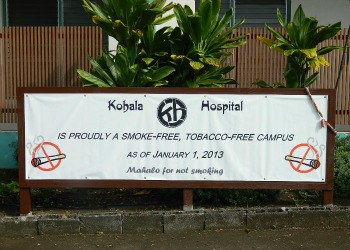
At our facilities, we strive daily to provide the safest, healthiest environment possible for our employees and patients.
Patients are not allowed to leave the hospital to smoke. We encourage all our patients to quit smoking or participate in smoking cessation activities. If you need help or would like more information, ask your doctor or nurse to contact our Respiratory Care Department. Protocols are in place to offer nicotine replacement therapy for patients, if needed.
We recognize that smoking and second-hand smoke can be harmful to your health and the health of others. For the health and safety of our patients, visitors and staff, we maintain a smoke-free environment. Smoking in the hospital facilities, on the sidewalks, roadways, parking lots, and grass areas is prohibited. If you have any questions, please call the Kohala Hospital admin at (808) 889-6211 or Kona Community Hospital at (808) 322-9311.
Smoking Cessation Education
- Smoking or quitting is personally relevant.
- Smoking has a lot of negative consequences, for example shortness of breath, worsening of asthma, and decrease in life span.
- Some of the long term risks are Heart Attack, Stroke and Lung Cancer. These negative consequences are some of the risks not just for the smoker, but include the harm it causes the people around you like your spouse. Your children are also at higher risk for asthma, respiratory infections, and sudden infant death syndrome.
- Quitting smoking has its rewards, such as a better sense of smell and taste, improved stamina, better self-image, and more money in your pocket. Quitting is not easy. It has many roadblocks like fear of failure, withdrawal symptoms, irritability, and sometimes weight gain, but you are worth the effort. It can be done.
- Half the people who ever smoked have quit either “cold turkey” (the hard way) or with medication support, counseling classes, or other interventions. They have no regrets.
- Many people relapse (start smoking again) within the first 3 months after quitting. It’s important not to get discouraged. Remember you get a little smarter every time you try again. Many people who have been able to “stay quit” have done it after trying to quit several times.
- Certain things or situations can increase your chances of smoking again, such as drinking alcohol, being around other smokers, gaining excess weight, stress, depression, or having more bad moods than usual. Talk to your health care provider to help avoid or deal with these situations.
- If you want to take charge, call the Hawaii State Tobacco QuitLine at 1 (800) QUIT-NOW: 1 (800) 784-8669. A personal tobacco cessation counselor is waiting to help you get started on your journey to a healthier place.